Showing posts with label enlightenment. Show all posts

Thursday, December 5, 2013

Where Most of Us Get Stuck: Understanding the Throat Chakra

By Sara Schwartz 

©Enid Johnstone

I once heard someone quote Sri Dharma Mittra and said that ‘most of us are stuck in our throat chakra.’ I’ve always wondered what that meant. With a little bit of research here’s what I came up with:

The chakra system is a description of our subtle anatomy and a part of the map of our spirit.

The seven chakras form at the intersections of our Ida and Pingala Nadis. These two main Nadis also intersect seven times along the Shashumna Nadi, the central energy channel which runs down our spines. Nadis, subtle energy channels, carry concentrated prana, or vital energy through our systems.

The idea is that our Divine Cosmic Energy, also known as Kundalini energy, lays dormant at the base of our spine. This is why our awareness of divine self is also dormant. As we practice, we raise our Kundalini energy from the base of our spines and we experience physical, spiritual, and emotional evolutions. The final destination is for Kundalini to unlock our seventh crown chakra, allowing us to experience enlightenment.

Each chakra has physical and spiritual manifestations based on whether it is closed, or if it is open. As the Kundalini rises and your chakras open, you evolve into each of the seven stages. By the time you get to your fifth chakra, your throat chakra, you are fairly evolved.

For example, the root chakra at the bottom of our spines deals with our base desires: Our need for food, sleep, and shelter. A person who is stuck at this level of evolution might hurt themselves or others to advance materialistically. A person with an open root chakra does not worry about where the food and money will come from but simply devotes his life to service, knowing the universe will provide.

The throat chakra is located somewhere around the base of the throat. A physical manifestation of an open throat chakra is a beautiful, clear, and resonant voice. You might have a good sense of hearing. Your shoulder and neck muscles are relaxed if your throat chakra is open. Physical manifestations of a tight throat chakra would be chronic head colds, thyroid imbalances, a tense neck and shoulders.


The Sanskrit name of the throat chakra is Vishuddha, which means purification. Emotionally, the throat chakra governs expression, so an open and healthy throat chakra means that we are comfortable telling the truth. With an open throat chakra we make sure that our actions serve the greater good and we embody a pure way of living.

The good news is that the Life of a Yogi Teaching Training Manual says, “Once one’s consciousness arrives at the Fifth Chakra, it never descends again.” The amount of knowledge it takes to progress up to your fifth chakra prevents you from descending back into ignorance.

When your consciousness is in your fifth chakra, your personality is marked by an interest in spiritual seeking. You try to cultivate, “self-denial, self-control, austerity, steadfastness, uprightness, renunciation, dedication, truthfulness and tranquility.” The throat chakra is a good place to be: spiritually aware and seeking, telling the truth, living a pure life.

But there is more on the spiritual path beyond the fifth chakra. Once in the sixth chakra, located at the space between your eyebrows, you can glimpse the spirit world in this lifetime.

So how can we evolve our consciousness past the throat chakra? Sri Dharma says, “After long and painful spiritual practices such as self-purification, the mind, heart, and intellect are purified and the consciousness is expanded to the level of Divine Perception.”

You can start this process of self-purification by watching what you say, and watching what you eat. Sri Dharma often says “If you control what you put into and what comes out of your mouth, you have controlled much of your mind already.” With that in mind, try following a vegan diet for a while, and thinking about what you say before you say it, and perhaps not saying most of what you intend to say.

Anodea Judith recommends you take a Vow of Silence to help heal the throat chakra. In her book Wheels of Life, she writes, “By avoiding verbal communication, one can open up other avenues of communication. Namely, communication with higher consciousness.”

Mouna, or spiritual silence, is a great way to deepen your connection to the divine. Think of the second yoga sutra of Patanjali: “Yoga is the settling of the mind into silence.” So to be verbally quiet is a good start to being mentally quiet.

To be in the throat chakra evolution-wise is a good sign. And it would make sense that most of us are stuck in the throat chakra because we are sincerely practicing, but maybe not predicting the future quite yet.

Om Namo Shivaya! 


_____________________________________


Sara Schwartz lives in Queens, New York with her husband Yancy. She currently teaches at Yoga to the People, where she received her 200-hour certification in 2010. She graduated from the Dharma Yoga Life of a Yogi 500-Hour Teacher Training in 2013. "Offer up the fruits of your practice" is her favorite advice from Sri Dharma Mittra. She is very grateful for the guidance of Sri Dharma and all of his teachers.


Thursday, November 14, 2013

Why read the Dhammapada?

by Fay Inger

©Enid Johnstone

When reading through the Dhammapada, I found that many verses resonated with me and I wonder if this is because I read the verses with yogi colored glasses because I studied with Sri Dharma Mittra

When a modern day Guru such as Sri Dharma recommends a book, it makes it less obscure and more approachable. Certainly, many verses touched upon themes I learned in the Life of a Yogi (LOAY) Teacher Training program, and when reading, I imagined seeing Sri Dharma’s face with a glimmer in his eye! 

Because of the similarities between the words of the Buddha and Sri Dharma, it is no wonder that Sri Dharma recommends this text as an important read for any new or experienced yogi.

There is a misconception that you must be a Buddhist or a person on a spiritual path seeking enlightenment to study the texts. In reality, this text is an important read regardless of one’s religious affiliation, because it transcends religion. In fact, there is no mention of religion at all. The book is not about religion or a higher power; it is about empowering the reader to be his or her best possible version by realizing that all the power is already within. (As I type this, I am aware of the strong correlation with how Sri Dharma encourages students to find their inner Guru).

Jack Kornfield, who wrote the foreword of the Gil Fronsdal translation of the Dhammapada, himself touches upon this very concept in the introduction, where he points out the contrast between the opening verse in the bible and the opening verses in the Dhammapada. As the author points out, the bible “emphasize God’s role as creator and, by extension, our reliance on God’s power.” This implies that we are weak in God’s shadow. Conversely, the Dammapada reflects “the importance and effectiveness of a person’s own actions and choices.” This observation highlights how we are in charge of our own path and indeed, the masters of our own destinies. The entirety of the text is reminding us of this fact in every capacity and function.

As the Buddha points out in the very first verse, it is our minds. “All experience is preceded by mind, led by mind, made by mind.” This sentiment reflects that Sri Dharma taught us that it is not we who are “bad,” it is our minds. It’s an important distinction, as it allows the individual freedom from our own thoughts and therefore actions - not to shirk responsibility of our deeds, but rather as a way to reflect on our own thoughts and regulate them before they turn into actions.

According to the Buddha, our very experiences start with the mind! Is it any wonder, then, that when going into a situation thinking it will be bad, it usually is? To tie this into asana: if, before attempting a posture, the thought is, “there’s no way I can do that,” you are right and it will indeed be impossible to do.  Sri Dharma, in his infinite wisdom has said, “If you can bend your mind, you can bend your body.”  How liberating then to take ownership over your own experiences!


The verse that I believe sums up the blueprint to living the life of a yogi is found in Chapter two, verse 25: “Through effort, vigilance, restraint and self control, the wise person can become an island no flood will overwhelm.” This is a powerful lesson to heed, as it sums up so much of Sri Dharma’s teachings. The Yamas and Niyamas, making an effort in asana -- regardless of what happens around you, inside you are unchanged. This is essentially the same lesson from the Buddha to Sri Dharma just in different words! This concept is again reflected in Chapter 3 verse 38: “For those who are unsteady of mind, who do not know true Dharma, and whose serenity wavers, wisdom does not mature.” In essence, if you want to be wise, the reader is given the exact route to take to achieve wisdom.  It is through steadying the mind, finding your Dharma and becoming serene. And the ultimate goal is to conquer oneself. 

According to the Buddha: “Greater in combat than a person who conquers a thousand times a thousand people is the person who conquers herself.”

And if one is simple and does not wish to be wise or to conquer him/her self? The Buddha has a blueprint for this person as well: “Doing no evil, engaging in what’s skillful, and purifying one’s mind: This is the teaching of the buddhas.”

I find this book to be a perfect companion to Sri Dharma’s teachings for a student like myself who is across the country from the center, or for a student who has never participated in a LOAY teacher training. While the words are different, the direction and ultimate goal is the same. If it is mastery of the self one is seeking, then the Dhammapada is a text that will help set one on the right path.

_________________________________________________
Fay Inger is a 800-Hour Certified Dharma Yoga instructor living in Los Angeles, California. Fay is a private yoga instructor, writes blog posts on yoga and wellness and is learning nutrition to better help her students reach their health and fitness goals. As she always says, “yoga is a gift” and it is her favorite gift to share!


Thursday, October 17, 2013

The Four Building Blocks of Meditation

By Alan C. Haras

 “After mastering the art of concentration, one proceeds to meditate.  The constant practice of meditation leads to realization of self.” Yogi Gupta


©Dharma Yoga Center

The Catholic theologian Walter J. Burghardt, S.J. referred to Meditation, or dhyana, as it is referred to in the Yoga Sutras, as the means through which we connect to the “portion of God dwelling in the center of our chest” – in the spiritual heart.

The various practices of yoga are designed to empower us with the ability to sit still long enough in order for the “mind to settle into silence”, revealing the changeless, eternal Self.

Let’s explore the various components of meditation, using the framework of Father Burghardt’s definition, and the substance of the yogic teachings as passed on by Sri Dharma Mittra.

·        Long

According to SwamiSivananda, concentration, or dharana, is defined as twelve seconds of unbroken focus on one point.  Meditation, or dhyana, is said to be about 2.5 minutes, while samadhi is about thirty minutes.
 
Sri Dharma Mittra emphasizes that the purpose of asana is intended to prepare one to sit in meditation long enough to perceive the Self.  Traditionally, it is said that one should build up to being able to sit for three hours without distraction.  

Of course, progress is made in stages.  Patanjali Maharishi says that, “The practice of yoga will be firmly rooted when it is maintained consistently and with dedication over a long period of time.”  The Dharma Yoga Life of a Yogi Teacher Training Manual reminds us that, “the more one practices, the faster progress is made.” 

·        Loving

In order to persevere in the practice of meditation, one must be motivated by a burning desire for liberation, or mumukshutvaWithout a passion for God or the Self, progress is virtually impossible.  One may be motivated to practice for a time out of fear, or a desire for some benefits, but it is really love which leads us onward, beyond ourselves. 

Patanjali says that samadhi comes from complete surrender to the Almighty One.   Surrender takes place when we love something more than we love our own illusions.  Of the nine different forms of yoga, bhakti yoga is the path of union with the Self through love.  Whether one is devoted to a particular form of God, one’s Guru or the Truth, the spiritual aspirant is spurred on by a love which consumes the small self and draws them into a transforming union with Ultimate Reality.

·        Look

There is a beautiful word in Sanskrit – darshan – which refers both to how one sees things, as well as to actually “to have sight of” something or someone.  When one goes to a temple or to see a Guru, one is going to have darshan.  This kind of “look” is not a stare or a glare, but a gaze, by which one sees beyond the appearance of things into the things into their essence.

This kind of vision is depicted in yogic literature and art as the “third eye” – a vision that sees beyond the apparent duality to the unity we all share.  The yogi is one who lives in two worlds at once – simultaneously aware of multiplicity, while remaining absorbed in the Supreme Self beyond names and forms.  One “sees”, not merely with physical eyes, but with the divine eye, or divya chakshu.

·        Real

When asked what is really Real, the great sage Sri Ramana Maharshi answered, “That which does not change.”  The question we must then ask is, “What does not change?”  We live in a world of constant change.  Change appears to be the only thing we can count on.  However, the yogis assure us that there is a changeless reality, but it is to be found only within.  It is known as the atman – the portion of God residing within our own heart.  This atman, the changeless reality within us, is said to be identical with Brahman – the changeless reality that pervades the entire cosmos.  This Supreme Self is like the movie screen upon which the play of names and forms unfolds, while remaining unstained by any of the moving pictures. 

The practice of meditation establishes us in the role of the eternal witness, observing the movements of the body, mind and emotions, without getting caught in them.  One is able to “do what needs to be done” without being identified with the “doer”, thus allowing the mind to remain absorbed in the Infinite.

1. The Yoga Sutras of Patanjali by Alistair Shearer
2. Fourteen Lessons in Raja Yoga by Swami Sivananda
3. Dharma Yoga Life of a Yogi Teacher Training Manual
4. Bhagavad Gita by Swami Nikhilananda.


---------------------------------------------------------------------------------------------------------------------------

Alan Haras (Bhaktadas Om) is the owner of Hamsa Yoga in Lake Orion, Michigan.  He holds a B.A. in Religious Studies from Michigan State University, is finishing up a two-year training in Spiritual Direction from the Manresa Jesuit Retreat House, and is pursuing his Masters in Religious Studies at the University of Detroit Mercy.  He has been blessed to spend three years studying Advaita Vedanta with Dr. John Grimes, ten years studying the Jivamukti Yoga method, as well as having spent time in India with the late kirtan-wala and bhakti yogi Shyamdas.  In 2012-13, Alan completed the 200, 500 and 800-hour Dharma Yoga Life of a Yogi Teacher Trainings with Sri Dharma Mittra, made a 12-day pilgrimage to the Holy Land, and completed the Spiritual Exercises of St. Ignatius.  As a teacher, he is deeply grateful for the opportunity to offer "the greatest charity of all" - sharing and promoting spiritual knowledge.


Thursday, August 22, 2013

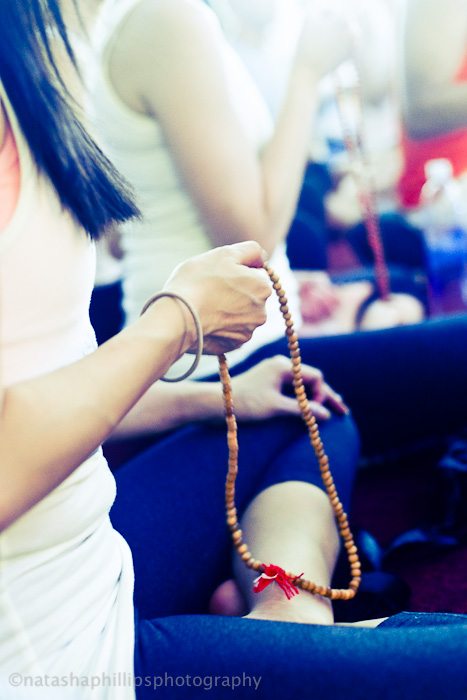
What is a Mantra?

By Alan C. Haras

©Natasha Phillips

In the 3rd and 4th centuries, many spiritual seekers left Europe and traveled to the Egyptian deserts to approach wise men and women who had been living prayerful lives looking for God.  When they finally arrived at the cell of these wise men and woman (abba or amma), tradition says that these seekers would ask: “Abba, speak to me a word, by which I might have life.” They might then receive a “prayer-word” or some brief instruction.  The pilgrim would take this “word” back with them to their home country and build their spiritual life around this one “word.” 

In the yogic tradition, these “words of power” are called mantras, and they are traditionally whispered into the ear of the disciple by a guru.  The guru is someone who has realized the essence of a mantra.  The Sanskrit word guru actually means “weighty one”.  These gurus have gravitas, and their words carry a lot of weight.  Because the guru has yoked their mind and heart with Truth, when they are approached by a seeker who is humble and sincere, the Truth emerges from them as the perfect thing the student needs to hear to continue their journey.  Indeed, such words give life to the soul who is thirsty for God.

Traditionally, at the time of initiation one receives a mantra, a mala (rosary) and a spiritual name.  The ceremony marks a new birth for that individual into their spiritual family.  But in order to realize the full benefit of the mantra it should be “awakened and put into action.” 


©Jeffrey Vock

Along with receiving the mantra comes both the permission to us it, as well as transference of psychic power from the master.  The mantra contains within it the enlightened wisdom of the spiritual preceptor, and like a zip file, must be unpacked through continued repetition to reveal its full meaning and power.   

 The word mantra comes from two Sanskrit roots – man or manas which refer to the mind/heart, and tra which means “to protect”.  The root tra also means “to cross over” and comes into English words such as “travel” and “traverse”. 

The practice of mantra protects the mind and heart from distraction, and helps us to cross over the discursive mind.

There are many types of mantras.  Some are used to produce specific results - to overcome illness or to achieve worldly success - while others are employed solely for the purpose of Self-realization.


©Jeffrey Vock

Mantras sung in the spirit of devotion, with melody and rhythm, are known as kirtan – the foundational practice of bhakti yoga.  Other mantras are performed silently, like the Hamsa/Soham mantra which is produced effortlessly by the sound of the incoming and outgoing breath.  But the Guru Mantra is given special importance in the world of mantras. 

The mantra given by one’s guru at the time of initiation provides invisible protection for the disciple, and acts like the “red phone” at the White House during the Cold War – it is a direct line to the Supreme. 

Swami Satyasanghananda says that “the mantra is a link between you and the cosmos, between you and the deeper mysteries of the universe.” The specific number of the syllables in the mantra given by the guru is designed to make up for any deficiencies in the disciple’s aura or energetic body.  The more one recites the mantra, the more one gains spiritual wealth.

By establishing the psychic link with the guru through recitation of the mantra, one becomes receptive to spiritual guidance across all planes of existence, and is able to stir the spiritual awareness which resides in one’s spiritual heart.

As Sri Dharma Mittra says, the outer guru shows you how to find the inner guru, situated in the right side of the heart, in the center of the chest.  The practice of mantra is one proven method for gaining access to this sacred chamber of the heart - the goal of all spiritual disciplines.

1.     Yogi Gupta, Yoga and Yogic Powers (New York, Yogi Gupta, 1958), 52 - 62
2.     Swami Satyasanghananda Sarasvati, Light on the Guru and Disciple Relationship, 101
3.     Jonathan Wilson-Hartgrove, The Wisdom of the Desert Fathers and Mothers, (Paraclete Press) quote taken from Introduction.
4.     Maha Sadhana bySri Dharma Mittra (DVD) – Spiritual Discourses, The Importance of a Teacher

____________________________________________

Alan Haras (Bhaktadas Om) is the owner of Hamsa Yoga in Lake Orion, Michigan.  He holds a B.A. in Religious Studies from Michigan State University, is finishing up a two-year training in Spiritual Direction from the Manresa Jesuit Retreat House, and is pursuing his Masters in Religious Studies at the University of Detroit Mercy.  He has been blessed to spend three years studying Advaita Vedanta with Dr. John Grimes, ten years studying the Jivamukti Yoga method, as well as having spent time in India with the late kirtan-wala and bhakti yogi Shyamdas.  In 2012-13, Alan completed the 200, 500 and 800-hour Dharma Yoga Life of a Yogi Teacher Trainings with Sri Dharma Mittra, made a 12-day pilgrimage to the Holy Land, and completed the Spiritual Exercises of St. Ignatius.  As a teacher, he is deeply grateful for the opportunity to offer "the greatest charity of all" - sharing and promoting spiritual knowledge.

Thursday, July 18, 2013

15 Truths I learned from Sri Dharma Mittra

By Sorsha Anderson


Picture by Natasha Phillips

  1. To make progress you must learn to do three things: Fast, keep silent and wait...
  2. Breathe as slowly as possible for an hour and watch your cravings disappear. 
  3. See yourself in the practice you are not able to access right now.  Imagine yourself in it.   
  4. Do the work.  Not because you expect results, but because it’s work that needs to be done.  
  5. In the beginning, do the poses any way you can. 
  6. You can become king of the gods by watching…
  7. Cultivate compassion--the rest will come. 
  8. Expect nothing.  Do it because it has to be done. 
  9. Avoiding discipline is a trick of the mind.  It enjoys its pleasures.  The mind will throw you down.  It is powerful. 
  10. There is no ‘mine’.  Where there is ‘mine’, there is bondage.
  11. Be kind to all beings.  Everyone passes through the same obstacles.
  12. You can reach higher states with drugs, but there is a blackness behind it.  You despair because you know you cannot get there without the help.  When you achieve higher states with meditation, you feel bliss because you realize no one can take it from you.
  13. Yoga is…perfect obedience to the teacher.
  14. Drop the elbows. Don’t think!  Forearm stand!
  15. After enlightenment, there are plenty of exciting jobs for you to do! 


_________________________

Sorsha Anderson is a certified Dharma Yoga Teacher who lives and teaches in Vermont.  She has been practicing since 1991 and worked with very gentle and restorative yoga until her 30's when she wandered into a hot and sweaty, but meditative vinyasa studio.  Neither a dancer nor gymnast as a child, and after having had two children, she surprised herself by balancing in crow for the first time at 36.  She never looked back.  Sorsha approaches each new pose with a sense of optimism and adventure and delights in encouraging others to try what only seems impossible at first glance.  She particularly enjoys teaching older women who are trying to find their way back to their bodies after a sometimes very long absence.  Sorsha is thankful to have found her way to the Dharma Yoga Center and makes the trip from Vermont as often as she can.  She offers gratitude for the beautiful physical and spiritual teachings of Sri Dharma Mittra.


Friday, May 10, 2013

Ten Ways to Establish a Home Practice

By Jessica Gale

Moving to a new city and being short on cash, I realized it was time to establish my home practice. I was spoiled for the last 3 years with CNY Yoga Center (Dharma Yoga) in Syracuse, New York, literally down the street from me. However, last May after finishing my Dharma Yoga Life of a Yogi Teacher Training, I knew it was now or never.

After almost a year, I find myself at a happy medium. I enjoy my solitary practice and it’s become a habit in my life. I’m still far from the ideal practice I have envisioned in my mind, but I’m satisfied with the direction it’s going in. 


Here is what I learned:  

1.     Have clear goals

Why do you want to establish your own self practice? What sets it apart from your classes? What do you want to learn? Having defined reasons and goals before setting out helps you keep yourself focused and motivated.

2.    Practice even if you don’t have the ideal space

I like to practice in quiet, but sometimes my partner comes home earlier than expected. Sometimes the kids in the downstairs apartment are screaming. Sometimes it’s extremely hot in my apartment in the summer. These are not excuses. They are challenges.  Don’t make your practice so sacred there is no room for regular life to come in. Strive for a quiet, peaceful, and comfortable space to practice in, but take what comes in stride.

3.     Hold poses for three counts longer

Because you’re not in class, waiting for the teacher to make adjustments before the next pose, it is easy to speed through your practice. Slow down, breathe, and take at least three extra counts.

4.    Change up your routine

Although repetition can be an important part of yoga, boredom is a quick way to make quitting a new goal all the easier. There are literally hundreds of yoga poses and their variations, dozens of breathing techniques, and several mantras & meditations Dharma Yoga offers. All of these offer different benefits. Depending on your abilities you may be limited to certain poses, but there are still ways to change things up to offset tedium.

5.     Don’t forget pranayama and meditation

When time is short and you’re trying to fit in your practice, don’t skip breathing exercises and meditation! With yoga, we sometimes get so caught up in all the poses that we forget the incredible benefits of the other limbs. I like to remind myself what the ultimate goal of yoga is—stillness and union. Pranayama and meditation are essential to that final goal.

6.    Keep your mat by your side

I try to always bring my yoga mat with me when I travel. Sometimes it’s hard to find time and a space. Sometimes you’re surrounded by people. However, I look at this as an opportunity to share yoga with others by including family and friends in my practice, even just for sun salutations. They are likely curious what you’re up to—this is a great chance and a way to fit in your practice.

7.     Add yoga practice to your exercise routine

I took up running recently and find that yoga and running complement each other very well. They particularly fit together in my exercise routine.  Consider how you can include your asana into your other exercise. I find that a post run yoga practice is perfect for me.

8.    Do something, not nothing

If you have an hour—practice. Thirty minutes—practice. Fifteen—practice. Five—practice. Even a few sun salutations, a breathing exercise, and sitting quiet for a moment can be beneficial.

9.    It’s okay if you miss one day—just don’t let it become habit

Sometimes my day passes so swiftly, I realize I forgot to practice yoga. Sometimes things will be really crazy and I’ll miss two or three days. The important thing is I try not to let that become a habit. The more days pass between your last and your next self practice—the harder it will be to pick it up again.

10.                         Remember ahimsa, have compassion for yourself

Don’t be too hard on yourself if you run out of time or are simply too exhausted. Start the next day afresh and enjoy the time you do have to practice yoga.


_____________________________________
Jessica Gale has practiced yoga for nine years and studied Ashtanga, Kripalu and Dharma Yoga during this time. She spent the last three years studying intensely at CNY Yoga (Dharma Yoga) in Syracuse, New York and completed her LOAY 200-hour teacher training at the Dharma Yoga New York Center in May 2012. She is currently completing her internship hours and hopes to achieve full certification soon. Jessica lives in Toronto with her husband and is pursuing a career in environmental work along with flower farming, garden design, and, of course, yoga.