Showing posts with label students. Show all posts

Thursday, November 21, 2013

Tapas for Teachers

By Liz Schindler


“Yoga is the path of purification of character and conduct (the cleansing of one’s physical and mental nature) wherein the highest state of reality and truth may shine undiminished in the hearts and minds of all beings." –Sri Dharma Mittra

©Jeffrey Vock

 My Life of A Yogi Teacher Training Training wasn’t all rainbows and kittens! Well, it was mostly rainbows and kittens, but also a whole lot of tapas. Tapas is perhaps the most transformative of the niyamas, or personal disciplines, set forth by Patanjali in The Yoga Sutras as well as the basis for the “path to purification” that Sri Dharma Mittra refers to in his definition of yoga.

According to the LOAY manual, tapas is defined as heat, austerity, or burning away impurities through self-discipline. Tapas was at the beginning of my transformative journey and it fueled my passion to learn and grow and to push through self doubt. Tapas caused the deepening of my physical practice throughout the intensive ten days, fueled by my own fire and sweat. It was tapas that drove me to the training, got me through it, and forced a change in my body, mind and spirit.
       
Sri Dharma Mittra is referred to as the teacher’s teacher and for good reason! Sri Dharma is the perfect shepherd to the trainees because he didn’t only show us how to teach yoga classes, he shared his limitless experience, knowledge and wisdom.  The morning pranayama and spiritual discourse sessions were the highlight of my day and I cannot stress how challenging but rewarding the breath work was. I soaked up all the information on the kriyas, mantra, chakras, bandhas and mudras.  

©Jeffrey Vock

Yet there was still the element of tapas and the floor seemed to harden with each passing day and by day six easy poses were no longer easy. The pain of sitting with a tall spine (out of respect for Sri Dharma) was distracting at times but looking back I’m happy that I did it. It broke a mental barrier in my mind and got rid of “I can’t do this any longer” and replaced it with “I’m still doing this.” I read a quote somewhere that says “your mind will always give up before your body, just keep going” and I did.

The hard part was putting myself out there as a teacher and I cannot adequately express my horror as I taught my first Dharma I class to my group during the training. In contrast to my inexperience, my group was so advanced! Two of my group-mates had mothers that taught yoga and two others were already certified teachers. This was my first teaching experience ever and I was mortified. I remember my disappointment as I taught and how frustrated I was over the shakiness in my voice and the inaccuracy of my cues. But why was I so nervous? I had been falling on my sweaty face and loudly farting in front of these people for days! But suddenly their opinion mattered more than anything and I thought I was bombing it.


©Liz Schindler

After finishing my first practice teach (which felt like hours) my mentor Hannah Allerdice gave me an honest review of my teaching. She stressed her opinion that I would be a wonderful teacher because she could sense how much I cared about my students. At the time I thought she was just being kind, but looking back through my handy 20/20 hindsight goggles, I see she was on point. Because I care so much I was nervous and horrified while practice teaching. My drive to teach yoga stems from my gratefulness to all of my teachers for helping deepen my yoga practice and to open my heart. All I wanted then and now is to be able to share that same gift of yoga with my students.
       
By the end of the training I had more confidence in my teaching and a greater sense of sympathy for my own feelings. I made strong friendships and have new role models to look up to. I surpassed my own expectations and in turn have raised my self-expectations. The LOAY teacher training experience was truly life altering for me and I am forever grateful to Sri Dharma and all of his teaching staff. 
________________________________________________

Liz Schindler found yoga during a stressful period of her life and has returned to it again and again for over ten years to calm both body and mind. After moving to New York and beginning to study with Sri Dharma Mittra, she soon came to realize her need to share her love of yoga with others. Liz is a 200-Hour Certified Dharma Yoga Teacher. She currently lives and teaches in Brooklyn, NY.


Monday, September 16, 2013

Six Ways to Get the Most Out of Your LOAY Teacher Training

By Jennifer Helgren

©Jeffrey Vock

First and foremost: GO

“Always do what you are afraid to do”   --Ralph Waldo Emerson

When the thought of attending the 500-Hour Life of a Yogi Teacher Training first entered my mind, I almost automatically dismissed the idea.  I had so many reasons NOT to attend (mother of two young children, travelling husband, a plane ride away from NYC, no housing in the city, etc.)

What I learned was that when I committed to my dream, the obstacles fell away. It may take some time, and definitely some effort, but the result – well, is simply too great to put into mere words. Dive in, take a chance, and find a way to GO.

Second:  Open your mind and heart

“Be Receptive” --Sri Dharma Mittra

There will be moments in the training that will challenge you - physically, mentally, spiritually - and you must always remember that is why you are here. Open the whole of your mind, even the places that you are least aware of: the places that hold onto resistance.  Allow the words, people, experiences, and lessons to pour into those hidden places. Listen with an open heart and mind, and the information will be absorbed.  Weeks, months after you leave, you will hear these words and learn these lessons…they will reside in the mind and heart, and the space you created within. 


©Jeffrey Vock

Third: Put forth effort and use imagination

“Imagination is powerful. You go as far as you can imagine”-- Sri Dharma Mittra

You are going to be tired at some point. You will physically and mentally hit the proverbial wall.  You will move past it. I promise you, a second wind comes along and you will be renewed.

I second-guessed myself initially, but that fell away after time. My mind let go of the attachments to thoughts and emotions that often distract us and inhibit us from fully committing to something.  We live in the real world, and the world does not like to be left behind. It will pull at you, distract you, and sometimes overwhelm you.  Give yourself time to allow these things to come up. They are natural and they will pass.

Apply disciplined effort to your practice. Let the physical practice act as a brush to scrub away at whatever negative tendencies you may have.  Let it invigorate you, regenerate you. Your physical practice will grow by leaps and bounds through dedication and practice, practice, practice.

Finally, use your imagination – Sri Dharma talks about this often and it truly resonated with me. Imagine yourself to be a better person, mother, father, daughter, son, friend, partner – a better yogi. Use your imagination as fuel to show yourself that what you pursue is attainable through effort, dedication, study, and time. 

Fourth: Be a Student

“In learning you will teach and in teaching, you will learn” Phil Collins

Lose all preconceptions. Take off the teacher hat and allow yourself to commit to being a student. Listen and learn: from Sri Dharma, the mentors, your fellow trainees. Watch your own mind and learn how to apply all that you receive to yourself, your life, your teaching.  Apply the lessons to every aspect of your life. You will be amazed at how the things you are exposed to relate to your roles in life – as a person, yogi, teacher, parent, child, friend, partner, spouse. This is truly the LIFE of a yogi training!

Listen as much as possible. You will want to take notes, but if you can, take time to just be still and listen. Let go and simply absorb the information and the words.  Listen to other people’s questions and answers and try not to be too eager to answer them for yourself, even in your own mind. Let other people share, and let their knowledge and experiences become part of your own.

©Jeffrey Vock


Fifth: Smile, live, learn, laugh…and do your homework!

“Knowledge is a treasure, but practice is the key to it” Lao Tzu

Enjoy the training! Every day, it becomes more of a part of you and integrates itself into your very being. 

Sri Dharma is always quick with a smile and a kind-hearted joke. He understands the power of laughter and the importance of joy.  The training will go faster than you think, so soak up every minute! When you leave between sessions or after the final interval, do your homework!  Remember that you are going to be able to do it and what’s more, you will enjoy it. After my internship ended, I found that much of the homework has become a part of my daily life.  After talking with many other trainees, this is the case with most of us.  Carry it forward. Apply it. LIVE it. 

Sixth and finally: Go back

“Well, sometimes home is a person” --B.Revis

I understand how hard to is to travel to New York City. Still, I would encourage you to go back as much as you can. Go home, and by home I mean return to Sri Dharma and be in his presence. 

However, if you are very far and it is not possible for you to physically go, keep in touch with people through the internet, the phone, however you can to maintain the connection. I have found myself using Facebook to keep in contact with other trainees and to touch base with the Center – daily! You can see pictures of Sri Dharma, the mentors, your friends. You can read quotes from Sri Dharma (and yes, you hear his voice!) You see familiar faces and smiles and all at once, you are home. 

In closing, ultimately this experience is a very personal one. I wish that everyone who is undecided about going could understand one thing – you will never regret going, but you may regret having never been. 
____________________________________________

Jennifer has a undergraduate degree in Psychology and a Master’s Degree with a specialty in Counseling.  She had a career as a counselor working with clients of all ages and backgrounds, in varying environments, with a wide range of needs and concerns.  After her time as a counselor, Jennifer began her life as a mother, the most rewarding and challenging career of all. She believes that her education, practice, and history as a counselor, and mother, play an important role in her yoga practice and her teaching. She believes strongly that a truly dedicated spiritual and physical yoga practice can transform, enhance, and expand the life of the practitioner. Jennifer had the honor to study with Sri Dharma Mittra for both the LOAY 200- and 500-Hour Teacher Trainings, and recently graduated from the 500-hour Life of a Yogi Teacher Training. Jennifer studied with numerous other teachers, but continues to find her strength, inspiration, knowledge, direction, and guidance from Sri Dharma. She lives in Virginia Beach, Virginia with her husband and two children.  Jennifer teaches regular weekly classes in Virginia Beach and continues to travel to NYC at every available opportunity to study under Sri Dharma and the Senior Teachers at the NYC Center. 

Thursday, September 12, 2013

For Yoga Teachers: Five Ways To Serve With Joy

By Jessica Gale


©Jeffrey Vock

Recently, upon borrowing mats from a yoga center for a workshop, I reflected on new connections and coincidences since moving to Toronto, Canada, and teaching yoga.

I thought about my growing social circle and sharing yoga with them; the yoga center I borrowed mats from; the workshop venue which was rented inexpensively to me by friends of friends (whom I had taught at home); and that all these new contacts kept me in the loop of any new jobs and opportunities and promoted my teaching.

All of this started with my eagerness to share yoga and my belief in karma yoga (selfless service). Acts of selfless service are free from the idea of receiving something in return and instead focus on the act of giving and surrender.

Selfless service will always be a part of my teaching.  The wonderful surprise is that for all I give, positive returns come back to me.  

Here are a few ways to include selfless service in your life:

·        Teach for free or barter

One of my students has chronic Lyme disease. I too had Lyme disease for several years and know firsthand that yoga helps. When I met his partner and heard of his situation, I immediately offered to teach them both. They were reluctant at first because they could not pay but they were willing and wanted to barter. In exchange, I receive muffins, preserves, and other small treats every week when I come to teach. But the real payoff and is seeing a friend recovering from a lengthy illness and there is no amount of money that can match this true reward.

For many of us, yoga is sometimes our sole profession and teaching classes for free is not feasible. However, a few karma yoga classes go a long way in helping people that cannot afford to attend but will reap the benefits of yoga.

Students, the elderly, even the unemployed with limited or no income, would greatly appreciate this and many are willing to pay in their own way by service or gifts in kind. Know the limits to what you can give and then give as much as you can.

©Jeffrey Vock

·        Teach what someone wants to be taught

As lovers of yoga, we sometimes forget that yoga can be overwhelming for some people. For example, my neighbor had difficulty with her breathing and I offered to teach her yoga. She was keen to learn breathing exercises but due to her age and inexperience, was not interested in the physical practice. While I knew that she would benefit from the physical exercises, I decided not to push it and I only taught her some simple pranayama exercises.  She found relief from the exercises and continued to talk about how beneficial it for months afterwards.

·        Share your time and your experiences

People are very curious about yoga teachers and I often find myself answering questions and sharing what I know. It can be overwhelming when you are in the midst of something or in a hurry!  So when I find myself becoming anxious or glancing at my watch during these situations, I try to remember to slow down and to share what I was so lucky to learn.

·        Volunteer

My first connection to potential students was made through volunteering. I helped out twice a week at an urban farm for some time and it was fantastic to help nurture plants and assist busy farmers. A number of wonderful connections developed from this time and it all began with selfless service.


©Enid Johnstone

·        Focus on small acts

Selfless service may sometimes seem like a tall order but really it’s not!

We don’t have to make huge sacrifices to include it in our day. Small opportunities occur around us all the time, but the first step is to slow down.

Do you need to be the first person on the grocery line? Can you hold the door for the people coming in? Would you pick up your partners clothes if it was left on the floor? 

I believe the key to Karma Yoga is to remember Ahimsa (compassion or non-violence) and to think, what are the loving acts I can do today?


_____________________________________
Jessica Gale has practiced yoga for nine years and studied Ashtanga, Kripalu and Dharma Yoga during this time. She spent the last three years studying intensely at CNY Yoga (Dharma Yoga) in Syracuse, New York and completed her LOAY 200-Hour Teacher Training at the Dharma Yoga New York Center in May 2012. She is currently completing her internship hours and hopes to achieve full certification soon. Jessica lives in Toronto, Canada.

Thursday, August 22, 2013

What is a Mantra?

By Alan C. Haras

©Natasha Phillips

In the 3rd and 4th centuries, many spiritual seekers left Europe and traveled to the Egyptian deserts to approach wise men and women who had been living prayerful lives looking for God.  When they finally arrived at the cell of these wise men and woman (abba or amma), tradition says that these seekers would ask: “Abba, speak to me a word, by which I might have life.” They might then receive a “prayer-word” or some brief instruction.  The pilgrim would take this “word” back with them to their home country and build their spiritual life around this one “word.” 

In the yogic tradition, these “words of power” are called mantras, and they are traditionally whispered into the ear of the disciple by a guru.  The guru is someone who has realized the essence of a mantra.  The Sanskrit word guru actually means “weighty one”.  These gurus have gravitas, and their words carry a lot of weight.  Because the guru has yoked their mind and heart with Truth, when they are approached by a seeker who is humble and sincere, the Truth emerges from them as the perfect thing the student needs to hear to continue their journey.  Indeed, such words give life to the soul who is thirsty for God.

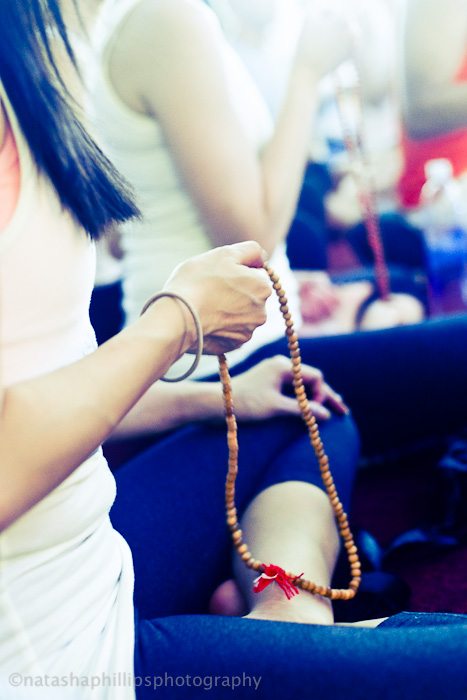
Traditionally, at the time of initiation one receives a mantra, a mala (rosary) and a spiritual name.  The ceremony marks a new birth for that individual into their spiritual family.  But in order to realize the full benefit of the mantra it should be “awakened and put into action.” 


©Jeffrey Vock

Along with receiving the mantra comes both the permission to us it, as well as transference of psychic power from the master.  The mantra contains within it the enlightened wisdom of the spiritual preceptor, and like a zip file, must be unpacked through continued repetition to reveal its full meaning and power.   

 The word mantra comes from two Sanskrit roots – man or manas which refer to the mind/heart, and tra which means “to protect”.  The root tra also means “to cross over” and comes into English words such as “travel” and “traverse”. 

The practice of mantra protects the mind and heart from distraction, and helps us to cross over the discursive mind.

There are many types of mantras.  Some are used to produce specific results - to overcome illness or to achieve worldly success - while others are employed solely for the purpose of Self-realization.


©Jeffrey Vock

Mantras sung in the spirit of devotion, with melody and rhythm, are known as kirtan – the foundational practice of bhakti yoga.  Other mantras are performed silently, like the Hamsa/Soham mantra which is produced effortlessly by the sound of the incoming and outgoing breath.  But the Guru Mantra is given special importance in the world of mantras. 

The mantra given by one’s guru at the time of initiation provides invisible protection for the disciple, and acts like the “red phone” at the White House during the Cold War – it is a direct line to the Supreme. 

Swami Satyasanghananda says that “the mantra is a link between you and the cosmos, between you and the deeper mysteries of the universe.” The specific number of the syllables in the mantra given by the guru is designed to make up for any deficiencies in the disciple’s aura or energetic body.  The more one recites the mantra, the more one gains spiritual wealth.

By establishing the psychic link with the guru through recitation of the mantra, one becomes receptive to spiritual guidance across all planes of existence, and is able to stir the spiritual awareness which resides in one’s spiritual heart.

As Sri Dharma Mittra says, the outer guru shows you how to find the inner guru, situated in the right side of the heart, in the center of the chest.  The practice of mantra is one proven method for gaining access to this sacred chamber of the heart - the goal of all spiritual disciplines.

1.     Yogi Gupta, Yoga and Yogic Powers (New York, Yogi Gupta, 1958), 52 - 62
2.     Swami Satyasanghananda Sarasvati, Light on the Guru and Disciple Relationship, 101
3.     Jonathan Wilson-Hartgrove, The Wisdom of the Desert Fathers and Mothers, (Paraclete Press) quote taken from Introduction.
4.     Maha Sadhana bySri Dharma Mittra (DVD) – Spiritual Discourses, The Importance of a Teacher

____________________________________________

Alan Haras (Bhaktadas Om) is the owner of Hamsa Yoga in Lake Orion, Michigan.  He holds a B.A. in Religious Studies from Michigan State University, is finishing up a two-year training in Spiritual Direction from the Manresa Jesuit Retreat House, and is pursuing his Masters in Religious Studies at the University of Detroit Mercy.  He has been blessed to spend three years studying Advaita Vedanta with Dr. John Grimes, ten years studying the Jivamukti Yoga method, as well as having spent time in India with the late kirtan-wala and bhakti yogi Shyamdas.  In 2012-13, Alan completed the 200, 500 and 800-hour Dharma Yoga Life of a Yogi Teacher Trainings with Sri Dharma Mittra, made a 12-day pilgrimage to the Holy Land, and completed the Spiritual Exercises of St. Ignatius.  As a teacher, he is deeply grateful for the opportunity to offer "the greatest charity of all" - sharing and promoting spiritual knowledge.

Thursday, July 18, 2013

15 Truths I learned from Sri Dharma Mittra

By Sorsha Anderson


Picture by Natasha Phillips

  1. To make progress you must learn to do three things: Fast, keep silent and wait...
  2. Breathe as slowly as possible for an hour and watch your cravings disappear. 
  3. See yourself in the practice you are not able to access right now.  Imagine yourself in it.   
  4. Do the work.  Not because you expect results, but because it’s work that needs to be done.  
  5. In the beginning, do the poses any way you can. 
  6. You can become king of the gods by watching…
  7. Cultivate compassion--the rest will come. 
  8. Expect nothing.  Do it because it has to be done. 
  9. Avoiding discipline is a trick of the mind.  It enjoys its pleasures.  The mind will throw you down.  It is powerful. 
  10. There is no ‘mine’.  Where there is ‘mine’, there is bondage.
  11. Be kind to all beings.  Everyone passes through the same obstacles.
  12. You can reach higher states with drugs, but there is a blackness behind it.  You despair because you know you cannot get there without the help.  When you achieve higher states with meditation, you feel bliss because you realize no one can take it from you.
  13. Yoga is…perfect obedience to the teacher.
  14. Drop the elbows. Don’t think!  Forearm stand!
  15. After enlightenment, there are plenty of exciting jobs for you to do! 


_________________________

Sorsha Anderson is a certified Dharma Yoga Teacher who lives and teaches in Vermont.  She has been practicing since 1991 and worked with very gentle and restorative yoga until her 30's when she wandered into a hot and sweaty, but meditative vinyasa studio.  Neither a dancer nor gymnast as a child, and after having had two children, she surprised herself by balancing in crow for the first time at 36.  She never looked back.  Sorsha approaches each new pose with a sense of optimism and adventure and delights in encouraging others to try what only seems impossible at first glance.  She particularly enjoys teaching older women who are trying to find their way back to their bodies after a sometimes very long absence.  Sorsha is thankful to have found her way to the Dharma Yoga Center and makes the trip from Vermont as often as she can.  She offers gratitude for the beautiful physical and spiritual teachings of Sri Dharma Mittra.


Friday, June 7, 2013

Coming Home

By Barb Cooper

“Welcome home,” I thought as I walked through the door of the Dharma Yoga Center (DYC) to attend the graduation ceremony for the Life of a Yogi teacher training program. “Welcome home.”


©Natasha Phillips

Although I live on Long Island, I hadn’t been back to the DYC since my training ended in early March.  Life as a householder seemed to perpetually intervene as I struggled to complete all of the requirements for graduation while maintaining my own daily practice.  But as soon as I walked through the doors, I felt like a weary traveler coming home after a long time away. The atmosphere of the DYC was exactly as I remembered it - serene and quietly spiritual.  Just being there unties all of the knots I have inside.

Sri Dharma Mittra taught a Master Sadhana at noon, and seemed pleased by the number of graduates who had invited their families to class.  He seemed to delight especially in the children, pausing briefly once or twice to bend a seemingly boneless child into an advanced posture - and then grinning at the rest of us as he acknowledged how effortless it was for her. 

I watched him and reflected on the joy he brings to each encounter.  As a newly minted yoga instructor, I paid close attention to the way he taught, trying to learn from the master.  I saw him do something I have seen him do before and marveled at each time. It is difficult to describe, but it seems to me that he, without any fanfare or fuss, takes in the collective energy of the room  - the various physical ability levels and varying levels of spiritual knowledge - and then he lifts everyone up beyond their own best level. It is astonishing, but goes largely unremarked upon.  People just know that something special is happening in each class taught by Sri Dharma, even if they don’t know quite what it is.

That same spirit was evident as the graduation ceremony began.  First an hour of Satsang and Kirtan, and then Sri Dharma bestowed the certificates on the graduates.


©Natasha Phillips

Afterwards, he spoke with his customary wisdom and humor about the yoga teacher training.  “The teacher training is like a course in self realization because all of the spiritual knowledge - the highest spiritual knowledge - is imparted to you.  And then automatically, even in ten days, everybody will change completely. “  I know this to be true from my own experience.  When I came back from my training, I was surprised people even recognized me - I felt utterly transformed.


©Natasha Phillips

Sri Dharma went on to remind us that the point of the yoga teacher training is to help us help others.  “It is very good to see thousands of new teachers, so that with our thoughts, we can gradually change the world - send peace to the world.  That’s the best contribution to world peace - first the students should find their peace, and then they share with the other students.”

That’s really sums up everything I’ve learned from the teachings of Sri Dharma Mittra, the Life of a Yogi teacher training, and my own yoga practice.  We learn from Sri Dharma, who is much further down the path to enlightenment than we are, and in turn, we pass the knowledge we gain to those coming along behind us.  In the process, we change the world even as we change ourselves.


©Natasha Phillips


_________________________________________________

Barb Cooper, 48, is a mother, a well-socialized introvert, a Texas-to-New York transplant, and a writer by nature and training. She considers herself a grateful observer, a recovering perfectionist, and no longer shy. Barb graduated from the Dharma Yoga Life of a Yogi Teacher Training in June 2013. She is beginning to become the person her pets think she is. Barb@sothethingis.com


Friday, May 24, 2013

Ten Tips for New Teachers…

by Jason Zagaro

As you grow as a yoga teacher, you realize there is a lot more happening during a “typical” class than you may have first realized.  

When I first began teaching, my main concerns were: (1) avoiding injuries and (2) timing - how in the world was I going to fill 75 minutes? 

Time is usually something that consumes the mind of a novice teacher  - we think too much and too fast, speak too fast, move too fast...  

Patience is a virtue as a teacher and it gets developed over time. You cannot please everyone in class. Stay true to yourself; be creative but don’t stray too far from your wheelhouse. Eventually your composure, personality, structure and experience will take over as a teacher.  


The following are ten teaching tips that I have discovered over the years of being a yoga instructor:

1. Keep it simple. 
Don’t try and be the best yoga teacher on the planet and remember everything they taught you in your training. If Sanskrit words come naturally and you feel comfortable using them, then do so. Otherwise, work on filling your time and watching the room so people don’t get injured. 

2. Decide what level of preparation is your preferred method. 
Some teachers have no idea what pose is coming next. Some teachers have the class scripted to the T. Some even sequence the entire class set to the music they play. Many teachers just teach on a whim, spontaneously reacting to who is in the room. A good teacher teaches to the level of the room.

 3. Bad music is more of a factor than good music.
If the music is “bad” or inappropriate for a yoga class, it can really dampen or ruin the class. Everybody remembers a teacher who plays awful music and it can even deter the students from going back to that class. My first teacher in college had one CD and for three years he played the same CD in every class. The CD was Krishna Das' Pilgrim Heart, which was my first introduction to kirtan. I remember my first year training with him and I thought, “This music is awful!” After constantly hearing the same songs over and over, my frame of mind finally adjusted and I began to like the CD. If I hear Pilgrim Heart being played in a yoga studio now, I get flashbacks to that time in my life. Some lineages of yoga don’t have music at all; they want you to work on calming the mind, which means no distractions from your asana class.  

4. Be grateful to your students for coming to class.
I am always grateful to everyone who comes to take my class, even if some don’t follow the code of asana class perfectly. The fact that people would pay their hard earned money, drive to the studio, part from their families or home life for a period of time to listen to what I have to say and be guided by me as a teacher really makes me feel grateful.  

5. Set the guidelines for conduct in your classes.
As teachers, we are trained, and most of us practice, patience and understanding. We understand no one is perfect-- including ourselves as yoga teachers! Nonetheless, it is our responsibility to set the code of conduct for the class. Some teachers will tell me about students not acting appropriately and I always ask them if they discussed the problem with the student. Sometimes students are not being disrespectful, it is that they just don’t know the parameters of the class.  It is our job as teachers to educate them.  


6. Encourage Your Students to Practice Away from Class.
As teachers, we have instincts that grow over time. We can usually tell who has a solid home practice.  

 7. Help you students overcome their fears.
If your students have a lot of fears, practicing asana is a great way to work on those fears. As teachers we love to help those who are fearful about poses to overcome that fear. It is a process where we build the courage to take the first step, and then proceed from there.

8. Celebrate when a student achieves a pose.
If someone has been working on a pose and he or she finally gets it in the class, the teacher is just as excited as the student. To work so hard at something and then finally achieve that goal is such a rewarding concept.

 9. Pay some, but not too much, attention to your numbers.
As yoga teachers we care about bringing people to our classes and pleasing the owner of the studio where we are teaching. Numbers are not important in the concept of yoga, but revenue is part of the reality of teaching yoga today.

10. Don’t forget to take a moment to appreciate it all.
In the end, you’ve created a peaceful environment for the students and introduced the beauty of yoga and watched it transform lives. When the class is moving as one, as one heartbeat, and the students are moving in sync, take a moment to stand back and experience the gratitude of being a part of the peaceful unity that is occurring during the class. 

________________________________________________


Jason Zagaro graduated from the 500-Hour Dharma Yoga Life of a Yogi Teacher Training in March 2013. He's been studying Yoga tradition and philosophy for over eighteen years. Yoga has been the most wonderful experience that he has ever come across in his life. He started his training in 1995 with Ashtanga Yoga at the college that he attended, and later began to study and practice various forms of Hatha Yoga, Kripalu Yoga, Vinyasa Yoga, Integral Yoga and decided to become a certified Sivananda Yoga Teacher.