Showing posts with label yogi gupta. Show all posts

Thursday, August 22, 2013

What is a Mantra?

By Alan C. Haras

©Natasha Phillips

In the 3rd and 4th centuries, many spiritual seekers left Europe and traveled to the Egyptian deserts to approach wise men and women who had been living prayerful lives looking for God.  When they finally arrived at the cell of these wise men and woman (abba or amma), tradition says that these seekers would ask: “Abba, speak to me a word, by which I might have life.” They might then receive a “prayer-word” or some brief instruction.  The pilgrim would take this “word” back with them to their home country and build their spiritual life around this one “word.” 

In the yogic tradition, these “words of power” are called mantras, and they are traditionally whispered into the ear of the disciple by a guru.  The guru is someone who has realized the essence of a mantra.  The Sanskrit word guru actually means “weighty one”.  These gurus have gravitas, and their words carry a lot of weight.  Because the guru has yoked their mind and heart with Truth, when they are approached by a seeker who is humble and sincere, the Truth emerges from them as the perfect thing the student needs to hear to continue their journey.  Indeed, such words give life to the soul who is thirsty for God.

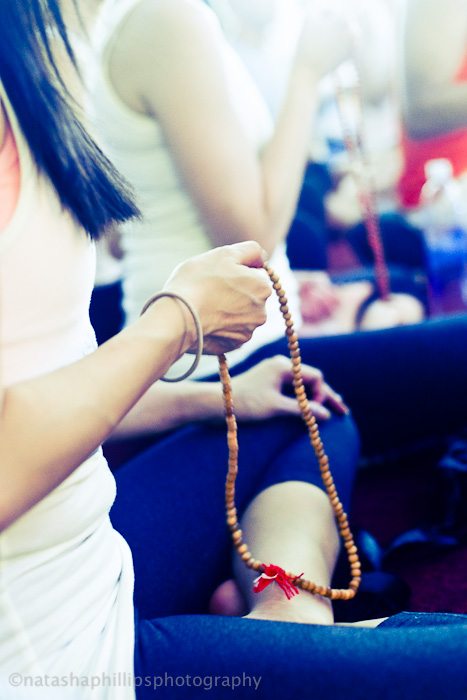
Traditionally, at the time of initiation one receives a mantra, a mala (rosary) and a spiritual name.  The ceremony marks a new birth for that individual into their spiritual family.  But in order to realize the full benefit of the mantra it should be “awakened and put into action.” 


©Jeffrey Vock

Along with receiving the mantra comes both the permission to us it, as well as transference of psychic power from the master.  The mantra contains within it the enlightened wisdom of the spiritual preceptor, and like a zip file, must be unpacked through continued repetition to reveal its full meaning and power.   

 The word mantra comes from two Sanskrit roots – man or manas which refer to the mind/heart, and tra which means “to protect”.  The root tra also means “to cross over” and comes into English words such as “travel” and “traverse”. 

The practice of mantra protects the mind and heart from distraction, and helps us to cross over the discursive mind.

There are many types of mantras.  Some are used to produce specific results - to overcome illness or to achieve worldly success - while others are employed solely for the purpose of Self-realization.


©Jeffrey Vock

Mantras sung in the spirit of devotion, with melody and rhythm, are known as kirtan – the foundational practice of bhakti yoga.  Other mantras are performed silently, like the Hamsa/Soham mantra which is produced effortlessly by the sound of the incoming and outgoing breath.  But the Guru Mantra is given special importance in the world of mantras. 

The mantra given by one’s guru at the time of initiation provides invisible protection for the disciple, and acts like the “red phone” at the White House during the Cold War – it is a direct line to the Supreme. 

Swami Satyasanghananda says that “the mantra is a link between you and the cosmos, between you and the deeper mysteries of the universe.” The specific number of the syllables in the mantra given by the guru is designed to make up for any deficiencies in the disciple’s aura or energetic body.  The more one recites the mantra, the more one gains spiritual wealth.

By establishing the psychic link with the guru through recitation of the mantra, one becomes receptive to spiritual guidance across all planes of existence, and is able to stir the spiritual awareness which resides in one’s spiritual heart.

As Sri Dharma Mittra says, the outer guru shows you how to find the inner guru, situated in the right side of the heart, in the center of the chest.  The practice of mantra is one proven method for gaining access to this sacred chamber of the heart - the goal of all spiritual disciplines.

1.     Yogi Gupta, Yoga and Yogic Powers (New York, Yogi Gupta, 1958), 52 - 62
2.     Swami Satyasanghananda Sarasvati, Light on the Guru and Disciple Relationship, 101
3.     Jonathan Wilson-Hartgrove, The Wisdom of the Desert Fathers and Mothers, (Paraclete Press) quote taken from Introduction.
4.     Maha Sadhana bySri Dharma Mittra (DVD) – Spiritual Discourses, The Importance of a Teacher

____________________________________________

Alan Haras (Bhaktadas Om) is the owner of Hamsa Yoga in Lake Orion, Michigan.  He holds a B.A. in Religious Studies from Michigan State University, is finishing up a two-year training in Spiritual Direction from the Manresa Jesuit Retreat House, and is pursuing his Masters in Religious Studies at the University of Detroit Mercy.  He has been blessed to spend three years studying Advaita Vedanta with Dr. John Grimes, ten years studying the Jivamukti Yoga method, as well as having spent time in India with the late kirtan-wala and bhakti yogi Shyamdas.  In 2012-13, Alan completed the 200, 500 and 800-hour Dharma Yoga Life of a Yogi Teacher Trainings with Sri Dharma Mittra, made a 12-day pilgrimage to the Holy Land, and completed the Spiritual Exercises of St. Ignatius.  As a teacher, he is deeply grateful for the opportunity to offer "the greatest charity of all" - sharing and promoting spiritual knowledge.

Friday, December 21, 2012

“Must Read” Yoga Book Review:
Yoga and Long Life, by Yogi Gupta


Katherine Labonte


The book Yoga and Long Life by Yogi Gupta is an absolute gem. It is one of my favorite yoga books. It is amazing how simple and yet in-depth it is at the same time. I am not sure I know any other yoga ‘manual’ that covers so much in such little space.

Yogi Gupta was obviously an intelligent man, and well learned. He starts out with such a clear message right on the cover page, with the symbol of Om and jnana mudra – symbolically representing the purpose, path, and result of yoga all in one.

The following topics are covered in the text: the definition of Yoga, Yoga and Christianity, philosophy of Yoga, types of Yoga, principles of relativity and duality, effects of Yoga, Yoga and Ayurveda, Yoga and Longevity, Yoga postures (asanas), breathing techniques, meditation, importance of Yoga, the necessity for a teacher, food and health, color and health, relaxation, and practice courses. Throughout the book, one can see that Yogi Gupta was familiar with all the main yogic texts. He refers to the following texts and authors: Patanjali’s Yoga Sutras, Goraksha Samhita, Hatha Yoga Pradipika, Rig Veda, Bhagavad Gita, Swami Vivekananda, Aldous Huxley, Gerald Heard, Christopher Isherwood, and Dr. Henry R. Zimmer to name just some.

What is a Yogic text, without a definition of Yoga? He defines Yoga as “a science of living.” What a beautiful definition. It is all-encompassing. He also states: “Yoga is a system of philosophic meditation and asceticism designed to affect the reunion of the soul with the universal spirit.” He makes it clear that it is not just for the body or mind, but for the spirit.

I love that he included a chapter on Yoga and Christianity, as, in my experience, so many Christians have been misled about Yoga being a cult or a religion, or “opening one’s mind to the devil.” He talks about Ghandi and Patanjali, and compares their teachings to Christ’s teachings. One example given of this is the yamas, or ethical rules. “Through Yoga a Hindu becomes a better Hindu, a Christian a better Christian, a Mohammedan a better Mohammedan, and a Jew a better Jew!”

Yogi Gupta refers to this text as a “handbook,” but I feel it is so much more. He says that we need to “transcend, as did the saints, the limits of the ‘gross’ physical self,” hence needing the techniques of yoga to bring us there. His explanation and diagram of the Ida and Pingala nadis and their purpose is very thorough. “It is by achieving a perfect equilibrium between these negative and positive influences in the body that the Hatha yogi reaches his goal.”
d
There are a variety of places in the book where he refers to such things as the importance of a guru, the yamas and niyamas, the eight limbs, maya, karma (or, with every action there is an equal and opposite reaction), but ultimately he says, “in the highest forms of yoga (like Raja-yoga), he [the yogi] transcends it [maya] in Samadhi when he becomes part of the Primal Force.” All yogis (and non-yogis alike) should read such a book so that it becomes clear how inter-related the entire body is. He portrays this message through his discussion on the glands, Ayurveda, and the Chakras.

To me, the main value of the book is to very clearly show the interconnectedness within the body-mind-spirit complex; and Yogi Gupta demonstrates that through diet, concentration/meditation exercises, asana, and pranayama, one can have a positive effect on the state of one’s mind, spirit, and physical health. So, if one is not yet deeply connected spiritually, the “hook” will be on the physical health.  He says, “prevention is better than cure.” He also says, “One should try to restore one’s health while remaining in one’s normal place of residence and continuing one’s work. One does not achieve a healthy body merely by fleeing to the Himalayas, California, Florida or other health resorts.” He is showing that it is accessible to anyone who puts forth the effort, finally stating, “it [health] cannot be bought.”

Today, we think of such things as color therapy and raw foods as “new age”. But, Yogi Gupta lived on raw foods for more than twenty years and says, “I feel much better for it.” It is amazing how much he knew about the increased nutrient value of food, long before there was much publicized on that. I can see why green juices are so valuable! The color green “influences the heart, blood pressure and the emotions, and vitalizes the nerves. It also imparts wisdom, peace, harmony, sympathy and generosity.” He connected the concepts of our raw food with the color of the food, and their vibrational qualities.

I am grateful for Yogi Gupta’s work in the Americas, with Sri Dharma Mittra, and now, God willing, through me.


Yoga and Long Life can be purchased at the Dharma Yoga NY Center boutique or through the online store.       
_________________________________________________

As a young woman, Katherine was a high school mathematics teacher about to embark on a Masters of Mathematics program. However, at the age of 28, Katherine recovered from a life-threatening and debilitating illness through Yoga and Colon Therapy. Ever since, she has been on a mission to share the profundity of both modalities, and to motivate others to delve deeper – both physically and mentally/ emotionally. Healing is found in the not so obvious 'nooks and crannies' of the body and the mind. She teaches private yoga, is a colon therapist, nutritionist, and instructor of colon therapy. She is eternally grateful for finding Sri Dharma Mittra and his complete Raja Yoga methods of healing, and hopes to spend the rest of her life sharing this with others.

Sunday, November 11, 2012

Day Eight: The Beginning


The Life of a Yogi


          I’m pretty reluctant to even write this blog entry right now, because that will make it feel like this whole experience is actually over… Last module, the last day was so much easier, just knowing that we’d all be back in two short months. I was saying to somebody the other day how I wish I could do this eight-day intensive experience every two months for the rest of my life; it’s just what I need to ground me and remind me of all the reasons why I aspire to be a Dharma Yoga teacher.
          Today was a perfect ending to the training. We started with pranayama and dhyana with Sri Dharma, followed by spiritual discourse. It’s sort of hard to explain the things covered in spiritual discourse, because somehow, every single lecture, Sri Dharma gives us the very essence of yoga, and at the same time gives each of us exactly the thing we need to hear at that moment. I am more amazed as I watch it over time, because it never fails.
          We had a partner yoga workshop after discourse (lots of fun pictures below), and then Dharma IV with Yoshio – the last asana practice of the training. I felt like I was just giving everything in that class. It’s sort of interesting how hard you work when you know you’re coming to the end of something!
          After lunch we had an oral final exam, which was not nearly as stressful as it might sound. We did it in our small groups, and we just had a few general knowledge questions, some asana demos, and some assisting and adjusting situations to work out. Then we went over the internship guidelines with Adam… I think if I hadn’t already done the 200-hour that discussion would have stressed me out a little bit, because it looks like so much on paper. I mean, it IS so much, in real life as well as on paper, but I know from experience that it is manageable, and it will happen in time.
          Then we had the closing satsang and received our completion certificates for the contact hours of the training. We opened the ceremony with some kirtan, of course, and I have never felt more joyful. I feel like this week has sort of just washed over me, and it hasn’t hit me yet that everything is finished… Because I think it sort of isn’t finished, you know?
          It doesn’t sound like much, reading over what I’ve written here. But this teacher training has changed my life, and will continue to influence my choices and my path probably for the rest of my life. Throughout my college years, when I was studying dance (which feels like a whole other lifetime now), I used to go to intensive summer programs where I’d get very close with other people… And of course we’d all be sad when they were done, but that was just nothing compared to this. The people I’ve met here are just beyond compare; the level of resonance and familiarity was astounding even from the very beginning. Dharma Yoga teacher trainings are pure bliss – there’s just no way to put it into words.
I could go on and on about how wonderful the whole thing has been, but I think Sri Dharma said it best (as always): You learn about something, and then “you have to check it out for yourself”.

~Danielle


Kim and Yoshio demonstrate some GORGEOUS partner yoga.


My yoga partner, Ana Cecilia, and I


More shots of Kim and Yoshio


A fellow trainee and her partner


We’ve been told several times this week that we look like sisters. Spiritual sisters, maybe?


My small group peeps!


The faculty organizes for a group shot


Sri Dharma sets up his camera


The final product


Me and my roomie, Lisa